Course Overview
This course introduces complex numbers, complex functions, analytic functions, complex integration and more.
As you progress through this course, you will find links to related topics in other courses (such as calculus, quantum mechanics and partial differential equations). This interconnected structure is designed to help you quickly revisit prerequisite ideas without breaking your workflow.
Introduction to Complex numbers
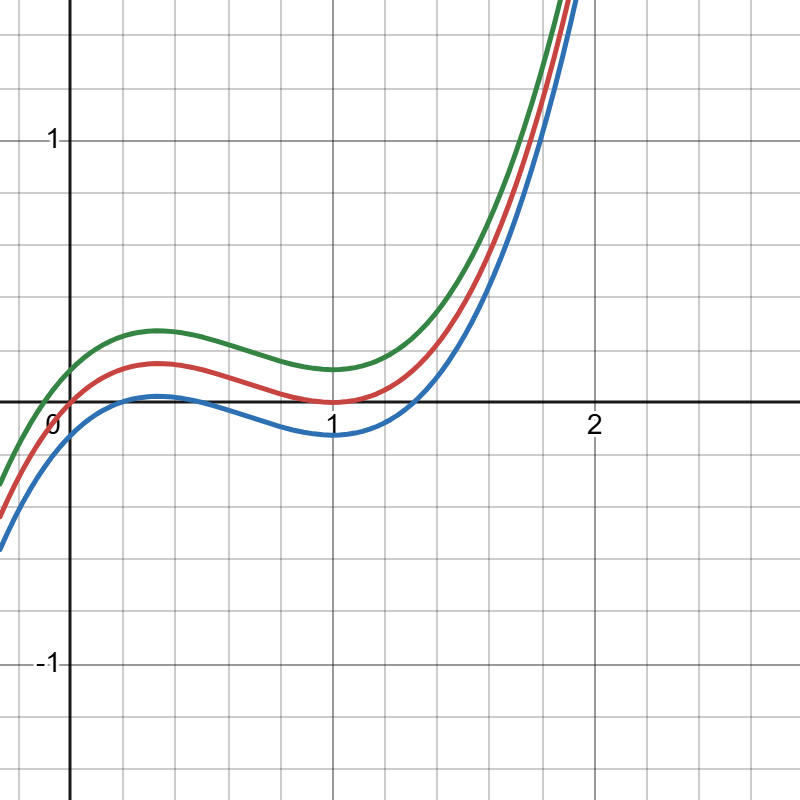 If we look at the plot above, what exactly happened as we moved from the lower (blue) curve, to the upper (green) curve? The obvious change is that we added a constant "shift"
term, which shifted the curve upwards, but notice that the lower curve passes through the \(x\)-axis 3 times, the middle curve only passes through the \(x\)-axis twice and
the upper curve only passes through it 1 time. We would say that these have 3, 2, and 1 real roots respectively. This leads naturally to the question, where did the other
roots go as we passed from the lower curve to the upper one? Since these are just shifted versions of each other, why don't they have the same number of roots? The middle curve
is somewhat easy to explain, two of the roots collapsed onto a single root (namely \(x=1\)) as the curved moved from blue to red. Technically the red curve still has 3 roots, but
one of those roots is degenerate, in this case that means that the \(x=1\) root should get counted twice. In fact this is easy to see from the red curves equation,
$$f(x) = x(x-1)^2.$$
However, when the equation moves upward to the green curve, with an equation,
$$g(x) = x(x-1)^2 + 0.125,$$
there are no longer any degenerate roots (because of the addition of the term \(0.125\) it is clear that \(x=1\) no longer gives us \(0\)). So where did those other two roots go?
If we look at the plot above, what exactly happened as we moved from the lower (blue) curve, to the upper (green) curve? The obvious change is that we added a constant "shift"
term, which shifted the curve upwards, but notice that the lower curve passes through the \(x\)-axis 3 times, the middle curve only passes through the \(x\)-axis twice and
the upper curve only passes through it 1 time. We would say that these have 3, 2, and 1 real roots respectively. This leads naturally to the question, where did the other
roots go as we passed from the lower curve to the upper one? Since these are just shifted versions of each other, why don't they have the same number of roots? The middle curve
is somewhat easy to explain, two of the roots collapsed onto a single root (namely \(x=1\)) as the curved moved from blue to red. Technically the red curve still has 3 roots, but
one of those roots is degenerate, in this case that means that the \(x=1\) root should get counted twice. In fact this is easy to see from the red curves equation,
$$f(x) = x(x-1)^2.$$
However, when the equation moves upward to the green curve, with an equation,
$$g(x) = x(x-1)^2 + 0.125,$$
there are no longer any degenerate roots (because of the addition of the term \(0.125\) it is clear that \(x=1\) no longer gives us \(0\)). So where did those other two roots go?
If you want the fast version, below is a short video introducing limits.
Though this is not exactly how the question was pitched at the origin of experimentation with complex numbers, a variation on this question was being asked. What was interesting of course was the solutions of any general cubic equation, $$x^3+a_2x^2+a_1x+a_0 = 0,$$ where the coefficients \(a_2,a_1,a_0 \in \mathbb{R}\) (that is each of those coefficients are real numbers). And if you haven't guessed the answer to my question above, what happened to those other two solutions is that they were "pushed" into the complex plane. So, while one real root always remains for the cubic no matter how much I increase or decrease the constant I add on (or any cubic for that matter with real coefficients), the other two roots become imaginary. Interestingly, when those coefficients are real, we are guaranteed that the imaginary roots will come in complex conjugate pairs (don't worry we will define the complex conjugate shortly if you have never heard that term).
Complex algebra
We will now introduce the algebra of complex numbers, as it will be important as we move forward. We generally think of a complex number (often represented as \(z\)), as an ordered pair (like a point in the plane), that is \(z = (x,y)\) for \(x,y \in \mathbb{R}\). Another way you will commonly see them written is, \(z = x+yi\) for real numbers \(x,y\), and for the number \(i = \sqrt{-1}\). The ordered pair formulation helps us understand complex numbers geometrically in the plane. This is a popular way of understanding things because this is generally how our understanding of complex numbers progressed historically. An important property that we have is that, \((x,y) = (u,v)\) if and only if (we will denote if and only if with iff from now on), \(x = u, \ \mbox{and} \ y = v\).
Now we would like to actually perform algebra with complex numbers. Since the complex numbers in most cases (not all, for instance they do not form an ordered field, while the real numbers do) behave like real numbers, we should formulate addition and multiplication of complex numbers. Let \(z_1 = (x_1,y_1), z_2 = (x_2,y_2)\) then, $$z_1+z_2 = (x_1+x_2, y_1+y_2).$$ This is easy enough to prove with our other notation, \(z_1 = x_1+y_1 i, z_2 = x_2 + y_2 i\), thus $$z_1 + z_2 = x_1 + y_1 i + x_2 + y_2i = (x_1+x_2) + (y_1 + y_2)i,$$ which quite obviously is the same as we noted above in the ordered pair notation. For some this may be easier to grasp with examples, so let \(z_1 = (1,-5), z_2 = (-2,-3)\), then, $$z_1 + z_2 = (1+(-2), -5+(-3)) = (-1,-8).$$ Since subtraction is defined similarly, $$z_1 - z_2 = (1-(-2), -5 -(-3)) = (3,-2).$$
For multiplication of complex numbers, it is probably tempting to try and define it as \(z_1z_2 = (x_1x_2, y_1,y_2)\) but this is quite clearly just plain wrong. You should think about this for a moment before reading my answer as to why it is "quite clearly just plain wrong". The reason is that there are a couple of related glaring problems with defining things this way. The first, is we know that \(i = \sqrt{-1}\), so naturally, \(i^2 = \sqrt{-1}^2 = -1\), which is a real number. We can write \(i\) in our notation as \((0,1)\). So, if we defined multiplication as we did above we would find that \((0*0,1*1)\) which gives \((0,1)\), but this is definitely not what we want, because \(i^2 = (-1,0)\). Another easy way to see this fails, is that we know that 1 multiplying anything should give the number itself back. This extends to the complex numbers as well, so we should find that \(1*i = i\), but note that in the complex numbers \(1 = (1,0), i = (0,1)\) and by our wrong definition of multiplication, \((1*0, 0*1) = (0,0)\) which again is not what we want! How do we get what we want? If we define multiplication as follows, $$z_1z_2 = (x_1+y_1i)(x_2+y_2i) = x_1x_2+x_1y_2i+x_2y_1i+y_1y_2i^2 = x_1x_2+x_1y_2i+x_2y_1i-y_1y_2,$$ where we note in the last step that \(i^2 = -1\). What this means in our ordered pair notation is that, $$z_1z_2 = (x_1x_2 -y_1y_2, x_1y_2 + x_2y_1).$$ Now we should test this out on the examples I gave before to make sure this makes sense, for instance if \(z_1 = z_2 = i\) (that is \(z_1z_2= i^2 = -1\)), then, $$z_1z_2 = (0*0 - 1*1, 0*1+0*1) = (-1,0),$$ which is exactly what we expect! Now we should try \(1*i = i\), $$z_1z_2 = (1*0-0*1, 1*1+0*0) = (0,1),$$ again exactly as expected! We can obviously include more sophisticated examples, for instance let \(z_1 = (1,1), z_2 = (3,5)\), then, $$z_1z_2 = (1*3-1*5, 1*5+3*1) = (-2,8).$$